
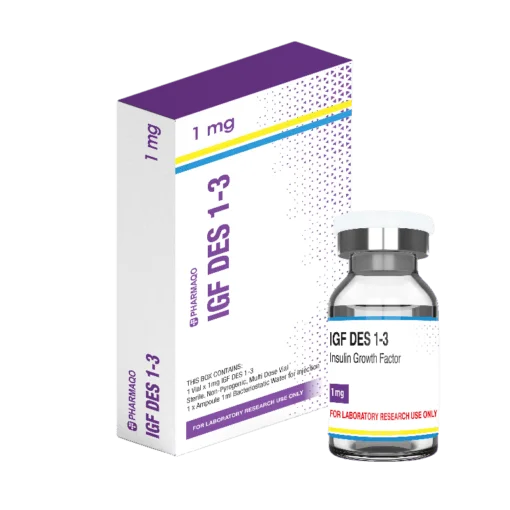

Pharmaqo UK – IGF-DES 1-3: Educational Guide to Des(1-3) IGF-1, Biological Activity, Risks, and Safety
Pharmaqo UK – IGF-DES 1-3 is a product name associated with Des(1-3) IGF-1, a modified form of insulin-like growth factor-1 (IGF-1).
IGF-1 is a naturally occurring hormone and growth factor involved in cellular growth, development, and metabolism. Des(1-3) IGF-1 is a modified IGF-1 analogue studied in scientific and experimental contexts.
The exact identity, concentration, purity, sterility, stability, and manufacturing quality of any specific product marketed as Pharmaqo UK IGF-DES 1-3 should not be assumed from the product name or packaging alone.
Unlike approved prescription medicines, research-oriented or unregulated peptide products may not have undergone the same rigorous regulatory review for human use, quality control, safety, or clinical effectiveness.
What Is IGF-DES 1-3?
IGF-DES 1-3 refers to a modified form of IGF-1 commonly known as Des(1-3) IGF-1.
The name reflects a structural modification of the IGF-1 molecule.
IGF-1 is a peptide growth factor that plays a role in:
- Cell growth
- Tissue development
- Protein metabolism
- Bone growth
- Muscle physiology
- Glucose regulation
Des(1-3) IGF-1 has been investigated for its biological activity and interaction with IGF-related pathways.
However, scientific interest does not automatically establish safety or efficacy for human use.
Understanding IGF-1
Insulin-like growth factor-1 is produced naturally in the body, with the liver being an important source.
Growth hormone stimulates IGF-1 production, creating an interconnected growth hormone–IGF-1 system.
IGF-1 can influence multiple tissues and biological pathways.
Its effects include interaction with cellular receptors involved in growth and metabolism.
Because these pathways affect many body systems, manipulating IGF-related signaling may produce effects beyond a single target tissue.
What Makes Des(1-3) IGF-1 Different?
Des(1-3) IGF-1 is a modified IGF-1 molecule.
Structural changes may affect how a peptide interacts with binding proteins and receptors.
The biological properties of modified peptides can differ from those of naturally occurring hormones.
However, the exact effects of a particular product depend on:
- Molecular identity
- Purity
- Concentration
- Stability
- Manufacturing quality
- Individual physiology
A product name alone cannot establish that a vial or container actually contains the stated peptide.
Experimental and Research Context
Des(1-3) IGF-1 has been discussed in scientific research involving cellular growth and IGF-related mechanisms.
Research compounds may be used in laboratory settings to investigate:
- Cell signaling
- Growth pathways
- Receptor activity
- Tissue biology
- Metabolic processes
Laboratory research findings should not automatically be interpreted as proof that a compound is safe or effective for human use.
The distinction between scientific research and approved medical treatment is important.
Potential Effects on Cell Growth
IGF-related pathways are involved in cellular growth and proliferation.
This is one reason why growth-factor analogues require careful consideration.
A substance that stimulates growth-related signaling may potentially affect different tissues differently.
The effects may depend on:
- Receptor distribution
- Existing health conditions
- Individual genetics
- Other hormones
- Underlying disease
Manipulation of growth-factor signaling can therefore involve complex risks.
Blood Glucose and Insulin Signaling
IGF-1 has biological similarities to insulin and may influence glucose metabolism.
Potential concerns may include:
- Changes in blood glucose
- Altered insulin sensitivity
- Hypoglycemia-related symptoms
- Metabolic disturbances
People with diabetes, insulin resistance, metabolic disorders, or other glucose-related conditions may face additional concerns.
Symptoms such as sweating, shakiness, confusion, weakness, dizziness, or fainting require medical attention.
Hypoglycemia Concerns
Changes in glucose regulation can potentially lead to low blood sugar.
Possible symptoms may include:
- Shaking
- Sweating
- Hunger
- Weakness
- Dizziness
- Confusion
- Difficulty concentrating
- Loss of consciousness
Severe hypoglycemia can be life-threatening.
Anyone experiencing symptoms suggestive of significant low blood sugar should seek urgent medical assistance.
Growth and Tissue Effects
IGF-1 is involved in growth and tissue development.
Exposure to an IGF analogue may theoretically affect multiple tissues.
Potential areas of concern include:
- Bone
- Connective tissue
- Muscle
- Internal organs
- Other IGF-sensitive tissues
The long-term effects of unregulated exposure to modified IGF-1 analogues may not be well established.
Cancer and Tumor Considerations
Because IGF signaling is involved in cell growth and proliferation, IGF-related compounds raise important questions for individuals with active or previous cancers.
The presence of a growth-related pathway does not mean that a compound causes cancer, but it highlights why medical history is important when considering substances that influence cellular growth.
Individuals with a history of cancer or tumors should discuss any growth-factor-related therapy or exposure with a qualified healthcare professional.
Product Authenticity and Purity
A product labeled Pharmaqo UK IGF-DES 1-3 may not necessarily contain genuine Des(1-3) IGF-1.
Potential concerns include:
- Incorrect peptide sequence
- Incorrect concentration
- Degradation
- Contamination
- Substitution with another peptide
- Poor manufacturing quality
Peptides may be sensitive to environmental conditions such as heat, light, and improper storage.
A professional-looking label cannot independently verify the identity or purity of the product.
Stability and Storage Concerns
Peptide products may require controlled handling and storage.
The stability of a peptide can be affected by:
- Temperature
- Light
- Moisture
- Repeated handling
- Improper storage
A product that has degraded may have reduced biological activity or altered quality.
Exact storage requirements depend on the specific formulation and verified manufacturer instructions.
Unregulated Peptide Products
Products sold outside regulated pharmaceutical systems may not undergo the same quality controls as approved medicines.
Potential concerns include:
- Inaccurate labeling
- Variable concentration
- Contamination
- Lack of sterility
- Lack of validated stability data
These issues are particularly important when a product is intended for administration into the body.
Legal and Regulatory Considerations
The legal status of Des(1-3) IGF-1 varies between countries.
Research peptides may be subject to different rules involving:
- Manufacture
- Importation
- Sale
- Possession
- Human use
A product being available online does not automatically mean that it is approved for human use or legally authorized for sale.
Frequently Asked Questions
What is Pharmaqo UK IGF-DES 1-3?
It is a product name associated with Des(1-3) IGF-1, a modified form of insulin-like growth factor-1.
What is IGF-1?
IGF-1 is a naturally occurring growth factor involved in cell growth, development, metabolism, and tissue biology.
Is Des(1-3) IGF-1 the same as regular IGF-1?
No. Des(1-3) IGF-1 is a structurally modified form of IGF-1.
Can IGF-related compounds affect blood sugar?
IGF-related signaling can interact with glucose metabolism, creating potential concerns involving blood glucose and insulin sensitivity.
Are online IGF-DES products always genuine?
No. Products from unregulated sources may be mislabeled, degraded, contaminated, or contain a different substance.
Is Des(1-3) IGF-1 an approved medicine everywhere?
No. Regulatory status varies between countries, and research or unregulated products should not automatically be considered approved medical treatments.
Final Educational Summary
Pharmaqo UK – IGF-DES 1-3 is a product name associated with Des(1-3) IGF-1, a modified analogue of insulin-like growth factor-1.
IGF-1 plays important roles in cell growth, tissue development, metabolism, and the growth hormone–IGF-1 system. Modified IGF-1 analogues have been discussed in scientific research, but research interest does not automatically establish safety, effectiveness, or approval for human use.
Potential concerns associated with manipulating IGF-related pathways include changes in glucose metabolism, hypoglycemia-related symptoms, effects on growth-related tissues, and uncertainty regarding long-term effects. Growth-factor signaling may also be particularly relevant to individuals with certain medical conditions, including a history of tumors or cancer.
The identity, purity, concentration, stability, and sterility of any specific product labeled Pharmaqo UK IGF-DES 1-3 should not be assumed from its name or packaging alone.
Anyone considering an IGF-related product or concerned about exposure to an unregulated peptide should consult a qualified healthcare professional.
Educational disclaimer: This article is provided for general educational and SEO purposes only. It does not endorse non-prescribed peptide use, does not confirm the composition of any specific product, and does not provide individualized dosing, reconstitution, injection, cycling, or performance-enhancement instructions.
Be the first to review “Pharmaqo Uk – IGF-DES 1-3”
Related products
Injectable Steroids
Injectable Steroids
Injectable Steroids
Injectable Steroids

Injectable Steroids
Injectable Steroids
Injectable Steroids
Injectable Steroids
Reviews
There are no reviews yet.