
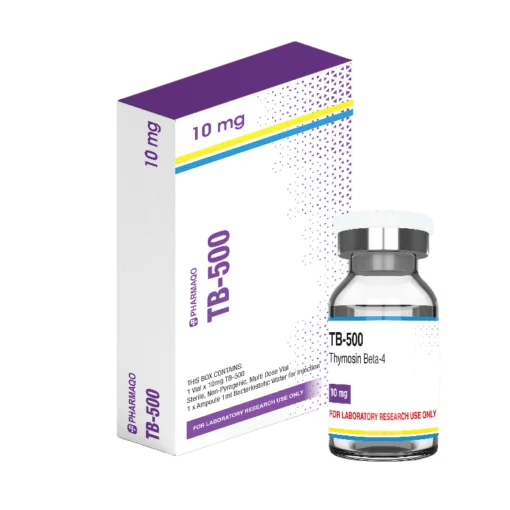
Pharmaqo UK – TB-500: Educational Guide to Thymosin Beta-4 Fragment, Research Status, Safety, and Risks
Pharmaqo UK – TB-500 is a product name associated with TB-500, a synthetic peptide related to a fragment of thymosin beta-4 (Tβ4).
TB-500 is frequently discussed online in connection with tissue repair, recovery, wound healing, and sports performance. However, many claims surrounding the peptide are based on laboratory and preclinical research rather than robust clinical evidence in humans.
The U.S. Food and Drug Administration (FDA) has stated that it has no human exposure data for drug products containing thymosin beta-4 fragment (TB-500) and lacks sufficient information to determine whether such products could cause harm when administered to humans. The FDA has also identified concerns involving peptide impurities, aggregation, and possible immunogenicity.
The exact identity, concentration, purity, sterility, stability, and manufacturing quality of any specific product marketed as Pharmaqo UK TB-500 should not be assumed from its name or packaging alone.
What Is Pharmaqo UK TB-500?
Pharmaqo UK TB-500 is marketed under the name of a synthetic peptide associated with thymosin beta-4 research.
The product is generally described as a peptide product rather than a conventional anabolic steroid or approved hormone replacement medicine.
Important considerations include:
- Product name: TB-500
- Related biological molecule: Thymosin beta-4
- Product category: Synthetic peptide
- Research context: Tissue repair and cellular biology
- Regulatory status: Not an FDA-approved medicine
The exact molecular form of a product called “TB-500” may be important because the term has been used in different contexts for thymosin beta-4-related materials.
What Is Thymosin Beta-4?
Thymosin beta-4 is a naturally occurring peptide found in many tissues.
It is involved in biological processes related to:
- Cell migration
- Cytoskeletal organization
- Tissue repair
- Angiogenesis
- Cellular signaling
Research into thymosin beta-4 has investigated its role in wound healing and tissue regeneration.
TB-500 is generally described as a synthetic fragment related to thymosin beta-4, but the biological properties of a specific fragment or formulation should not automatically be assumed to be identical to the full-length natural protein.
How Is TB-500 Studied?
Research involving thymosin beta-4 and related compounds has examined processes such as:
- Cell migration
- Wound healing
- Tissue remodeling
- Blood-vessel formation
- Cellular repair mechanisms
Much of the research supporting interest in these pathways is preclinical.
Laboratory findings involving cells or animals cannot automatically establish that a product is safe or effective in humans.
This distinction is especially important for products marketed through unregulated channels.
Potential Role in Tissue Repair
One reason TB-500 has attracted attention is its association with biological mechanisms involved in tissue repair.
Thymosin beta-4-related pathways have been studied in relation to the movement of cells into damaged tissue.
Researchers have also investigated the role of these pathways in processes associated with wound healing.
However, the presence of a plausible biological mechanism does not prove that an unapproved commercial product will produce a predictable clinical benefit.
Angiogenesis and Blood-Vessel Formation
Thymosin beta-4-related biology has also been associated with angiogenesis, the formation of new blood vessels.
Angiogenesis can be beneficial in some tissue-repair contexts.
However, growth of new blood vessels is a complex biological process.
Because angiogenesis may also be relevant to tumor biology, the long-term implications of manipulating related pathways require careful consideration.
This is one reason why claims about regenerative peptides should not be interpreted as proof of universal safety.
Human Evidence and Research Limitations
A major limitation of TB-500 is the lack of sufficient high-quality human evidence.
The FDA has stated that it has not identified human exposure data for drug products containing thymosin beta-4 fragment and lacks important information about potential safety issues.
This means that important questions remain regarding:
- Long-term safety
- Appropriate medical indications
- Human pharmacology
- Immunogenicity
- Product stability
- Optimal formulation
- Potential interactions
Preclinical research cannot replace well-designed human clinical trials.
Immunogenicity Concerns
Peptide medicines can sometimes trigger unwanted immune responses.
The FDA has raised concerns about possible immunogenicity related to TB-500, including risks associated with peptide aggregation and peptide-related impurities. These concerns may be particularly relevant to injectable preparations.
Potential immune reactions can vary considerably between individuals.
Possible concerns may include:
- Allergic reactions
- Immune responses to impurities
- Antibody formation
- Inflammatory reactions
The risk can be influenced by the peptide’s molecular structure, formulation, manufacturing process, and route of administration.
Product Purity and Manufacturing Quality
A product labeled Pharmaqo UK TB-500 may not necessarily contain genuine TB-500 or the stated amount of active peptide.
Potential concerns include:
- Incorrect peptide identity
- Inaccurate concentration
- Peptide degradation
- Aggregation
- Bacterial contamination
- Endotoxin contamination
- Other peptide impurities
The FDA has specifically noted concerns about the availability of appropriate testing for impurities, aggregates, microbiological quality, and bacterial endotoxins in TB-500-related products.
A professional-looking vial, label, or certificate of analysis cannot independently guarantee that a product is safe for human use.
Stability and Storage
Peptides can be sensitive to environmental conditions.
Factors that may affect stability include:
- Temperature
- Light
- Moisture
- Repeated handling
- Manufacturing conditions
Improper storage may cause degradation or changes in the product.
The exact stability requirements of a particular TB-500 product depend on its verified formulation and manufacturing specifications.
Injectable Product Concerns
Many products marketed as TB-500 are associated with injectable use.
Injectable products create additional safety concerns because they bypass natural protective barriers.
Potential risks include:
- Infection
- Abscess formation
- Tissue inflammation
- Contamination
- Immune reactions
A product described as “sterile” should not automatically be assumed to meet pharmaceutical sterility standards.
TB-500 and Athletic Use
TB-500 has gained attention in sports and bodybuilding communities because of claims involving recovery and tissue repair.
However, claims made in online fitness communities should not be confused with established clinical evidence.
Athletes should also consider anti-doping rules.
Peptide hormones, growth factors, and related substances may be prohibited in competitive sport depending on their specific classification and the applicable anti-doping regulations.
Legal and Regulatory Considerations
TB-500 is not an FDA-approved medicine.
The FDA has stated that drug products containing thymosin beta-4 fragment may present safety concerns and that important information regarding human exposure and potential harm is lacking.
Regulatory status varies between countries.
Rules may apply to:
- Manufacture
- Sale
- Importation
- Possession
- Human use
Online availability does not automatically mean that a product is approved, legal, or suitable for human administration.
Product Authenticity
Consumers should be cautious when evaluating products marketed under the name Pharmaqo UK TB-500.
Packaging, brand names, product photographs, and online descriptions cannot independently confirm:
- The molecular identity
- The actual peptide concentration
- The purity
- The sterility
- The stability
- The absence of contaminants
Independent laboratory testing may provide information about identity and purity, but testing does not necessarily establish that an injectable product is sterile or safe for human use.
Frequently Asked Questions
What is Pharmaqo UK TB-500?
It is a product name associated with TB-500, a synthetic peptide related to a fragment of thymosin beta-4.
What is thymosin beta-4?
Thymosin beta-4 is a naturally occurring peptide involved in biological processes including cell migration and tissue repair.
Is TB-500 FDA approved?
No. TB-500 is not an FDA-approved medicine, and the FDA has stated that human safety information is insufficient.
Has TB-500 been proven to heal injuries in humans?
There is insufficient high-quality human evidence to establish TB-500 as a proven treatment for injuries or other medical conditions.
Can TB-500 cause immune reactions?
Potential immunogenicity is a recognized concern, particularly in relation to peptide aggregation and impurities.
Are online TB-500 products always genuine?
No. Products from unregulated sources may be mislabeled, contaminated, degraded, or contain a different substance.
Final Educational Summary
Pharmaqo UK – TB-500 is a product name associated with a synthetic peptide related to thymosin beta-4.
Thymosin beta-4-related pathways have been studied in laboratory and preclinical research involving cell migration, tissue repair, and angiogenesis. However, the available evidence does not establish TB-500 as an approved or proven treatment for human injuries or other medical conditions.
The FDA has highlighted major knowledge gaps involving human exposure, safety, peptide impurities, aggregation, and immunogenicity.
Potential concerns with unregulated TB-500 products include uncertain identity, inaccurate concentration, peptide degradation, contamination, immune reactions, and unknown long-term effects.
The exact composition, purity, sterility, stability, and manufacturing quality of any product marketed as Pharmaqo UK TB-500 should not be assumed from the label or packaging alone.
Anyone considering an unapproved peptide or concerned about exposure to TB-500 should consult a qualified healthcare professional.
Educational disclaimer: This article is provided for general educational and SEO purposes only. It does not endorse non-prescribed peptide use, does not confirm the composition of any specific product, and does not provide individualized dosing, reconstitution, injection, cycling, or performance-enhancement instructions.
Be the first to review “Pharmaqo Uk – TB-500”
Related products
Injectable Steroids
Injectable Steroids
Injectable Steroids
Injectable Steroids
Injectable Steroids
Injectable Steroids
Injectable Steroids
Injectable Steroids
Reviews
There are no reviews yet.