
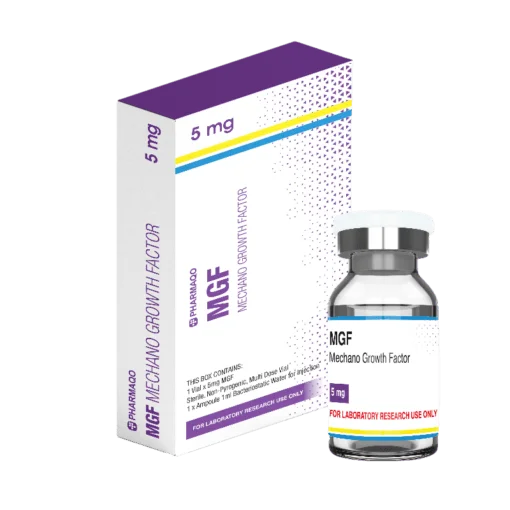


Pharmaqo UK MGF: Educational Guide to Mechano Growth Factor, Research Status, and Safety
Pharmaqo UK MGF is a product name associated with Mechano Growth Factor (MGF), a peptide related to an alternative form of insulin-like growth factor 1 (IGF-1). MGF has been studied in laboratory research involving muscle-cell biology, tissue repair, and regeneration.
However, the scientific literature on MGF is complex, and research findings are not entirely consistent. MGF is an experimental peptide rather than an established, approved human treatment, and the safety, effectiveness, quality, and authenticity of any specific commercial product should not be assumed from its label alone.
What Is Pharmaqo UK MGF?
Pharmaqo UK MGF is a product name associated with Mechano Growth Factor, commonly abbreviated as MGF.
MGF is associated with an IGF-1 splice variant and has been investigated in relation to:
- Muscle-cell biology
- Satellite-cell activity
- Tissue repair
- Regeneration
- Aging-related muscle changes
The exact identity, purity, concentration, stability, and authenticity of any specific product marketed under the Pharmaqo UK name cannot be confirmed solely from the product name or packaging.
What Is Mechano Growth Factor?
Mechano Growth Factor is a term used in scientific literature for a peptide or IGF-1-related splice variant associated with mechanical stress and tissue adaptation.
Early research investigated whether MGF-related peptides could influence muscle precursor cells and myoblast activity. Some laboratory studies reported effects involving cell proliferation and differentiation, while later research questioned whether certain proposed MGF mechanisms could be reliably reproduced.
This variation in research findings is important because laboratory results do not automatically establish a proven medical treatment.
MGF and IGF-1
MGF is related to the broader IGF-1 biological system.
IGF-1 plays important roles in biological processes involving:
- Growth signaling
- Cell development
- Tissue maintenance
- Muscle biology
MGF is associated with alternative IGF-1 gene expression and has been studied as a potentially distinct peptide-related signaling form. However, the exact biological role of MGF in humans remains an area of scientific discussion and investigation.
What Has Research Studied?
Research involving MGF has examined areas such as:
- Muscle-cell proliferation
- Muscle-cell differentiation
- Satellite-cell biology
- Tissue regeneration
- Age-related changes in muscle tissue
- Neurobiological research
Some laboratory studies have reported effects on human muscle progenitor cells, while other research has failed to reproduce certain claimed effects. This highlights the importance of distinguishing preliminary laboratory findings from established clinical evidence.
Limited Human Clinical Evidence
One of the most important limitations surrounding commercially marketed MGF products is the lack of robust clinical evidence establishing safe and effective human use.
Research findings from cells or animals cannot automatically establish:
- A proven human medical benefit
- Appropriate clinical use
- Long-term safety
- Product-specific effectiveness
The absence of adequate clinical evidence also makes it difficult to determine the long-term consequences of exposure to an unapproved or unverified MGF product.
Product Authenticity and Quality
A product labeled Pharmaqo UK MGF may not necessarily contain genuine MGF or the stated concentration.
Potential concerns associated with products from uncertain or unregulated sources include:
- Incorrect peptide identity
- Incorrect concentration
- Degradation during storage
- Contamination
- Counterfeit labeling
- Inconsistent manufacturing quality
The appearance of a vial, powder, or packaging cannot independently confirm identity, purity, potency, sterility, or safety.
Analytical testing, such as appropriate peptide characterization, may be required to verify the contents of a product.
MGF and Muscle Research
MGF has attracted attention because of its relationship to research into muscle adaptation and regeneration.
Some studies have investigated whether MGF-related peptides may influence muscle progenitor cells and tissue-repair pathways. However, the results have not established MGF as a proven treatment for muscle injury, muscle loss, or athletic performance.
Research findings should therefore be interpreted cautiously and should not be confused with clinical recommendations.
Potential Safety Concerns
Because commercially marketed MGF products may be unapproved or of uncertain composition, the complete safety profile is difficult to establish.
Potential concerns may include:
- Uncertain biological effects
- Product contamination
- Incorrect peptide identity
- Unexpected effects on growth-factor signaling
- Unknown long-term metabolic effects
- Unknown effects on tissues and organs
- Potential interactions with other substances
The risks may be especially difficult to predict when the actual contents of a product have not been independently verified.
Growth-Factor Signaling Considerations
MGF is associated with the IGF-1 system, which plays a role in cellular signaling and tissue biology.
Because growth-factor pathways are biologically active, manipulating them may have effects beyond a single tissue or muscle group.
The long-term consequences of externally introducing an unapproved growth-factor-related peptide remain insufficiently characterized.
MGF and Anti-Doping
MGF-related peptides have been identified in the context of anti-doping research.
Scientific literature has described MGF-related substances and methods for detecting certain forms of MGF in doping-control settings. The World Anti-Doping Agency’s prohibited-substance framework includes growth factors and related substances within prohibited categories, so athletes should consult the current rules applicable to their sport.
A positive anti-doping test can result in sporting sanctions.
Is MGF the Same as PEG-MGF?
No. MGF and PEG-MGF are not necessarily the same product.
PEG-MGF refers to a chemically modified, pegylated form intended to alter the peptide’s stability and pharmacokinetic properties. A product labeled simply MGF should not automatically be assumed to be PEG-MGF.
The exact formulation should be confirmed through reliable product documentation.
Frequently Asked Questions
What is Pharmaqo UK MGF?
It is a product name associated with Mechano Growth Factor, an IGF-1-related peptide studied in laboratory research involving muscle and tissue biology.
Is MGF a steroid?
No. MGF is a peptide-related growth-factor compound, not an anabolic steroid.
Is MGF the same as IGF-1?
No. MGF is associated with an IGF-1 splice variant and related biological pathways, but it should not automatically be treated as identical to mature IGF-1.
Is MGF approved as a general human treatment?
MGF products marketed for non-approved uses should not be assumed to be approved medicines. Human clinical evidence remains limited.
Is MGF the same as PEG-MGF?
No. PEG-MGF is a modified, pegylated form of MGF, while MGF refers to the unmodified or differently specified peptide depending on the product.
Can packaging confirm that a Pharmaqo UK MGF product is genuine?
No. Packaging alone cannot confirm identity, purity, concentration, sterility, or safety.
Has MGF been studied scientifically?
Yes. Research has examined MGF-related peptides in muscle-cell biology, regeneration, and other biological systems, although findings have varied and clinical evidence remains limited.
Final Educational Summary
Pharmaqo UK MGF is a product name associated with Mechano Growth Factor, an IGF-1-related peptide or splice-variant-associated research subject.
Scientific research has explored MGF in relation to muscle-cell activity, tissue regeneration, and biological responses to mechanical stress. However, the evidence is mixed, and laboratory findings should not be interpreted as proof of established human medical benefits.
The identity, concentration, purity, stability, sterility, authenticity, and manufacturing quality of any specific product marketed under the Pharmaqo UK name should not be assumed solely from its packaging.
MGF-related substances have also been relevant to anti-doping research and prohibited-substance considerations.
Educational disclaimer: This article is provided for general educational and SEO purposes only. It does not confirm the composition of any specific product, endorse the use of unapproved peptide or growth-factor products, or provide dosing, injection, cycling, stacking, or performance-enhancement instructions.
Be the first to review “Pharmaqo Uk – MGF”
Related products
Injectable Steroids
Injectable Steroids

Injectable Steroids
Injectable Steroids

Injectable Steroids
Injectable Steroids

Injectable Steroids

Injectable Steroids
Reviews
There are no reviews yet.